
Uncategorized
13 Business Sticker Branding Ideas That Work
07
Jul
Jul
A sticker on a plain satchel can feel like an afterthought. A sticker that carries your brand properly can turn the same package into something people remember, photograph and talk about. That’s the difference with smart business sticker branding ideas – they do more than fill space. They help your brand show up consistently, even in small moments.
For small businesses, tradies, event organisers and fast-moving retail brands, stickers are one of the easiest ways to get more mileage from every order, handout and customer interaction. They’re cost-effective, quick to apply and flexible enough to work across packaging, promotions, vehicles and in-store use. The trick is not just printing a logo and hoping for the best. The trick is using stickers with a clear job to do.
Business sticker branding ideas that pull their weight
The best sticker branding starts with a simple question – where does your customer actually see your brand? If you only think about the product itself, you miss half the opportunity. Customers notice parcels, takeaway bags, coffee cups, event packs, windows, laptops, hard hats, toolboxes and cars. Every one of those surfaces can reinforce your brand if the design is right.
A clean die cut logo sticker is the obvious starting point, and for good reason. It’s versatile, sharp and easy to use across packaging and promos. But if every sticker you print does the exact same thing, you’re probably leaving value on the table. A stronger approach is to build a small sticker mix around a few clear goals: brand recognition, customer experience and practical use.
That might mean one sticker for sealing boxes, another for handing out at events, and another for equipment or vehicles. Same brand, different jobs.
Use packaging stickers to make cheap packaging look premium
You do not need custom printed boxes for every order to look polished. A well-designed sticker can lift plain packaging fast. This is one of the easiest business sticker branding ideas to put into action because it works whether you’re shipping ten orders a week or hundreds.
Round or oval labels work well as box seals and tissue seals. Die cut stickers suit mailers and satchels where you want the logo to stand on its own. Clear stickers can look especially tidy on glass jars, takeaway containers or minimalist packaging, but they rely on good contrast. If your logo is too light, clear stock can lose impact.
The main trade-off is style versus readability. Fancy finishes can look brilliant, but if the sticker disappears against the packaging or becomes hard to scan at a glance, it’s doing less branding work than a simpler option.
Turn freebies into repeat brand exposure
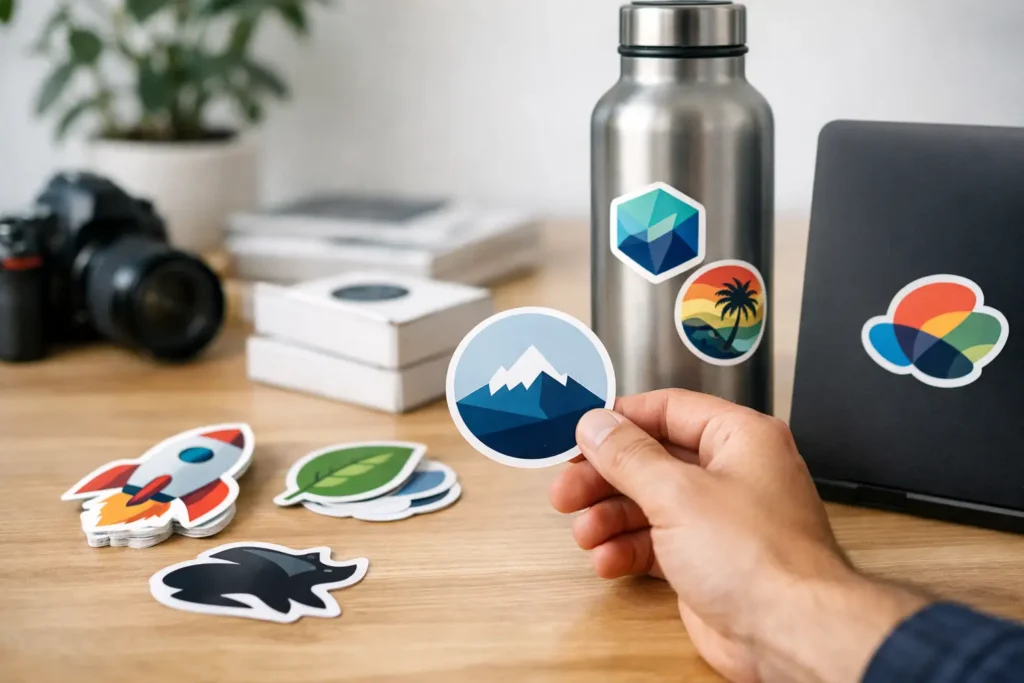
People rarely keep a receipt, but they’ll keep a good sticker. That’s why giveaway stickers still work. If the design has personality, customers put it on laptops, drink bottles, notebooks, eskies and car windows. Your branding keeps moving long after the sale.
This works best when the sticker feels like something someone would actually want. A plain logo can do the job for some brands, especially if the logo is strong. But a secondary design often performs better for giveaways – a slogan, mascot, icon or cheeky line tied to your brand. It still needs to look like you, just with a bit more attitude.
If you’re in a crowded category, this matters. A memorable sticker can separate your brand from five forgettable competitors selling the same type of product at the same market or expo.
Use sticker sheets when your brand has more than one message
Sticker sheets are underrated for campaigns, event packs and multi-product brands. They let you include a logo, supporting icons, taglines, QR prompt graphics, product callouts or seasonal designs in one neat format. They also feel more generous than a single sticker, which makes them great for welcome packs and promotional bundles.
This option suits brands that want more storytelling in the design. A café could include a logo, coffee-themed graphics and a couple of playful lines. A real estate team could use brand marks, suburb-specific graphics and sold-style badges. A tradie brand might include safety icons, jobsite humour and branded contact decals.
The catch is clutter. If you jam too much onto a sheet, the whole thing starts to feel cheap. Strong spacing and a clear visual hierarchy keep it looking intentional.
Sticker branding ideas for different business types
Not every business needs the same sticker strategy. A beauty brand, a plumbing business and an event organiser all use stickers differently. Good branding follows the way you work.
Retail and ecommerce brands
For retail and ecommerce, packaging is the obvious win. Logo stickers on satchels, thank-you seals on tissue and promotional stickers added as freebies all help create a better unboxing experience. If you sell products in jars, bottles or boxes, labels also do serious heavy lifting by combining branding with product info.
Holographic stickers can work well for limited runs, seasonal drops or youth-focused brands that want more shelf punch. They are not for every business though. If your brand is understated or premium in a quiet way, holographic stock can feel off-brand pretty quickly.
Tradies and service businesses
Tradies often overlook stickers because they associate them with retail packaging. That’s a miss. Utes, toolboxes, helmets, site folders, invoice packs and equipment all offer branding space. Durable bumper stickers or hard-wearing die cut stickers can keep your name visible on the move and on-site.
The key here is legibility. Tiny text and overworked designs fail from ten metres away. For service businesses, clarity beats cleverness most of the time. A strong logo, a short service line and readable contact detail can do more than a busy graphic ever will.
Real estate and local area marketing
Real estate operators already know visibility matters. Stickers can support that in subtle but useful ways – branded window decals, office signage, open-home packs, settlement gifts and folder labels all help reinforce recognition.
For local area campaigns, consistency matters more than novelty. People need to recognise your brand fast across signs, brochures, stickers and event material. If your sticker design feels like a separate identity, it weakens the overall effect.
Events, clubs and community groups
Stickers are made for events. They work as entry pack inclusions, merch add-ons, sponsor exposure pieces and quick visual branding on folders, bags or equipment. They also carry beyond the event itself, which is where the real value kicks in.
For clubs and community groups, sticker sheets and die cut stickers usually hit the sweet spot. They’re easy to distribute, low-fuss and good for fundraising packs or member gifts. If budget is tight, a smaller run of well-designed stickers can still go a long way.
What makes a business sticker actually feel branded
A sticker is small, but it should still follow the same rules as the rest of your brand. That means using the right logo version, the right colours and typography that matches your other materials. Random sticker artwork might look fun in isolation, but if it does not connect back to your brand identity, it won’t build much recognition.
Strong branded stickers usually have one focal point. That could be the logo, a phrase or a single graphic device. When businesses try to cram in a website, phone number, social handles, slogan and five design effects, the result is usually muddy.
Size matters too. A tiny sticker with too much detail looks messy. A large sticker with too little detail can feel generic. It depends on where it’s going and how long someone will look at it. Packaging stickers can be simpler because they support a broader brand experience. Promotional stickers often need more personality because they have to stand alone.
Material choice matters just as much as design. Gloss can make colours pop. Matte can feel cleaner and more premium. Clear stock looks slick when used properly. Holographic stock grabs attention fast. There’s no universal best option – only the one that fits the job, the surface and the brand.
How to choose the right business sticker branding ideas
Start with one use case, not ten. If your biggest pain point is bland packaging, fix that first. If you need better handouts for markets and expos, build for that. If your vans and gear have no visible branding, start there. The smartest move is usually to solve the most obvious brand gap before adding extras.
Then think about volume and turnaround. If you need stickers often, choose formats you can reorder easily and use across multiple jobs. If you’re testing a campaign or a seasonal look, keep the first run tighter so you can adjust. That’s especially useful when trying new finishes or more playful designs.
And do not treat proofing as a formality. Small print products can still go wrong if contrast, cut lines or sizing are off. Getting the artwork right before print saves money and headaches later.
For businesses that want fast, sharp, Australian-made sticker printing without the usual muck-around, Sticker Ninja keeps it simple. Pick the right format, get your artwork sorted, and put your branding to work where people will actually see it.
The best sticker ideas are not the flashiest ones. They’re the ones your customers notice, remember and keep around longer than you expected.