
Uncategorized
What Size Should Stickers Be? A Practical Guide
19
Jul
Jul
A sticker that is too small disappears on the shelf. One that is too big can swamp the packaging, look awkward on a car door, or blow out your budget. So, what size should stickers be? The right answer starts with where they will live, what they need to say, and how far away people will see them.
There is no single best sticker size for every job. A tiny logo seal on a candle jar has a completely different brief to a bold bumper sticker for a tradie ute. Get the scale right and your artwork looks deliberate, professional and worth keeping. Get it wrong and even a great design can feel a bit off.
What size should stickers be for their purpose?
Start with the surface, not the artwork. Measure the usable area where the sticker will go, then leave a little breathing room around the edges. A label that fills every millimetre of a bottle or box can look cramped, especially if the surface is curved.
Think about viewing distance too. If someone picks up the product, they can read fine details on a 50 mm label. If they are walking past a shop window, driving behind your vehicle, or spotting your event gear across a field, you need larger lettering and a bigger sticker overall.
A good rule is simple: the more information you need people to read, and the further away they will be, the bigger the sticker should be. That does not mean making every sticker huge. It means giving the logo, message and any key contact details enough room to do their job.
Popular sticker sizes and where they work
For many business orders, these starting points make the decision easier:
- 30-50 mm suits product seals, small logo stickers, jar lids, party favours and compact packaging.
- 60-75 mm is a strong all-rounder for branded handouts, takeaway packaging, drink bottles, laptops and smaller product labels.
- 80-100 mm works well for retail packaging, event giveaways, larger logos and decals people will actually want to stick on a laptop or water bottle.
- 100-150 mm gives vehicle decals, window stickers, safety messaging and bold promotional designs enough presence to be seen.
- 150 mm and above is usually for large vehicle graphics, signage-style decals, displays and simple messages viewed from a distance.
These are starting points, not rules carved in stone. A 75 mm circular sticker can look spot-on for a simple logo, while the same size may be too tight for a logo, QR code, phone number and three lines of text. Shape changes the available space as well. A long horizontal sticker fits a web address beautifully, while a circle may better suit a badge-style logo.
For product packaging and labels
Packaging stickers need to look like they belong there. Measure the flat face of the packet, tub, box, jar or bottle, then keep the sticker inside that area. On a curved surface, go slightly smaller than you first expect. Large stickers can wrinkle or lift at the edges if they have to bend too far around a container.
For small jars and cosmetic tubs, 40-60 mm round labels are common. For coffee bags, gift boxes and mailer boxes, 75-100 mm gives your branding more impact without taking over the whole pack. If the label carries ingredients, directions, batch details or other must-read information, prioritise legibility over squeezing in a decorative border.
For cars, utes and work vehicles
Vehicle stickers need to be read quickly. A small logo can work on a side window or rear quarter panel, but it will not carry your business name from three lanes away. For a simple logo decal, 100-150 mm is often a sensible place to begin. For a business name, phone number or service list, the dimensions should be driven by the panel available and the size of the text.
Keep the message short. A 300 mm sticker with one strong logo and a clear phone number generally works harder than a bigger decal packed with tiny details. Bumper stickers are often around 75 x 250 mm, but a custom die cut shape can make a brand feel far more memorable when the design calls for it.
For events, clubs and giveaways
Giveaway stickers need enough visual punch to earn a spot on someone’s laptop, esky, water bottle or tool box. Around 75-100 mm is the sweet spot for most event logos, bands, car clubs and branded illustrations. It feels generous without becoming awkward to apply.
If the sticker is part of a welcome pack or a low-cost handout, smaller can make sense. A 50-60 mm logo sticker is easy to distribute in volume. For a limited-run design people will collect, a larger 100 mm die cut or holographic sticker can feel more like a proper keepsake.
Choose the shape before locking in dimensions
Size and shape work together. Do not decide you need a 100 mm sticker until you know whether it is round, square, rectangular or die cut around the artwork.
A 100 mm square has much more usable room for text than a 100 mm circle. A 100 mm wide rectangle may only be 40 mm high, which is ideal for a URL but not for a detailed illustration. Die cut stickers are brilliant for bold logos, mascots and distinctive product shapes, but overly fine edges and skinny parts can make application harder.
Kiss cut stickers offer another option when you want the sticker itself cut to shape but prefer a larger backing sheet for easy peeling and handing out. Sticker sheets are handy when you have several smaller designs, product variants or a campaign that deserves more than one moment of attention.
Make sure the artwork still works at that size
Before ordering, shrink your artwork on screen to the intended printed size. Can you still read every word? Are fine lines still visible? Is the QR code large enough to scan reliably? If the answer is no, simplify the design or increase the sticker dimensions.
Small stickers need bold choices. Use fewer words, thicker lines, clean type and decent contrast between the background and text. Pale colours on a white sticker may look subtle on screen but can lose impact in real life. If your brand palette is light, a darker outline or coloured background can give it the edge it needs.
For print-ready files, build the artwork at the final size wherever possible. High-resolution images matter, particularly when you are printing photos, gradients or detailed illustrations. A blurry logo does not become sharp because it is printed on premium material. If you are unsure, getting an artwork proof checked before production is the smart move.
Consider quantity, budget and durability
Bigger stickers use more material, so size affects the total price. That should not push you into ordering a sticker too small to work, but it is worth being strategic. Sometimes a 75 mm sticker in a higher quantity delivers more reach than a large sticker that only goes to a handful of customers.
Material matters too. Indoor product labels can be relatively compact and detailed. Stickers going on vehicles, outdoor equipment, bins or shop windows need a size and finish that stays visible after sun, rain and everyday wear. Clear stickers look sharp on glass and coloured packaging, but the artwork needs enough contrast against whatever sits behind it. Holographic stickers add instant attention, although tiny text can become harder to read against the shifting finish.
A quick way to choose with confidence
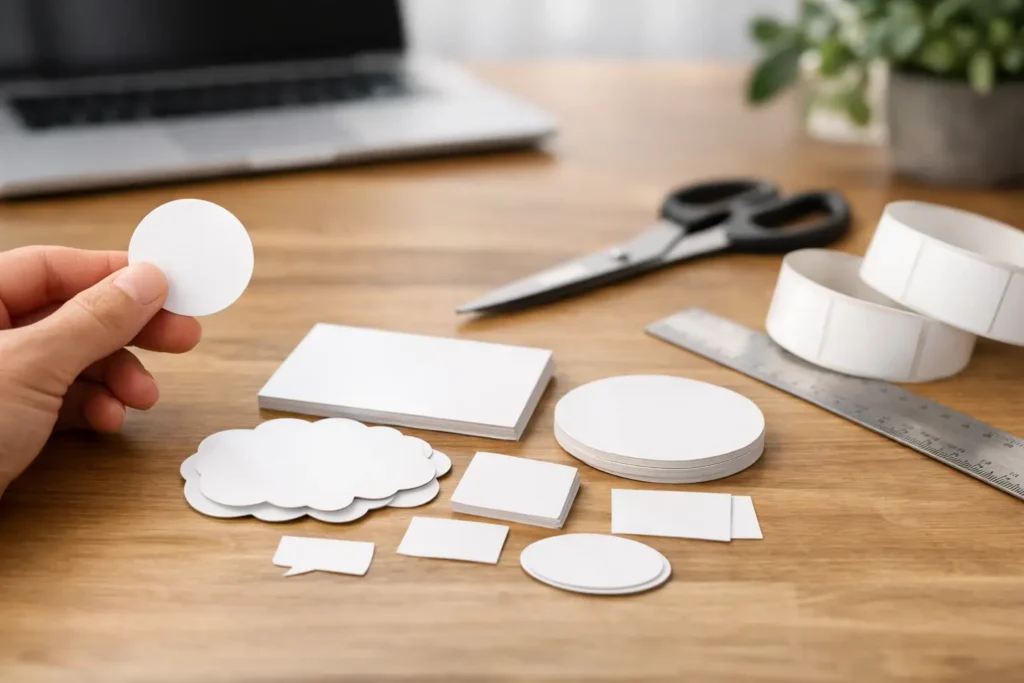
Grab a piece of paper and cut it to the size you are considering. Hold it against the box, bottle, car panel or display surface. Step back to the real viewing distance. This low-tech test catches a surprising number of sizing mistakes before they become a print order.
Then ask three no-fuss questions: can people read the important bit, does the sticker suit the available space, and will it still look good once applied? If all three are a yes, you are close. If not, adjust the dimensions before adding more design elements.
Sticker Ninja can help turn a rough idea into a size that looks properly dialled in, whether you need neat product labels or decals built to get noticed. Pick the space first, keep the message clear, and let the sticker earn its spot.