
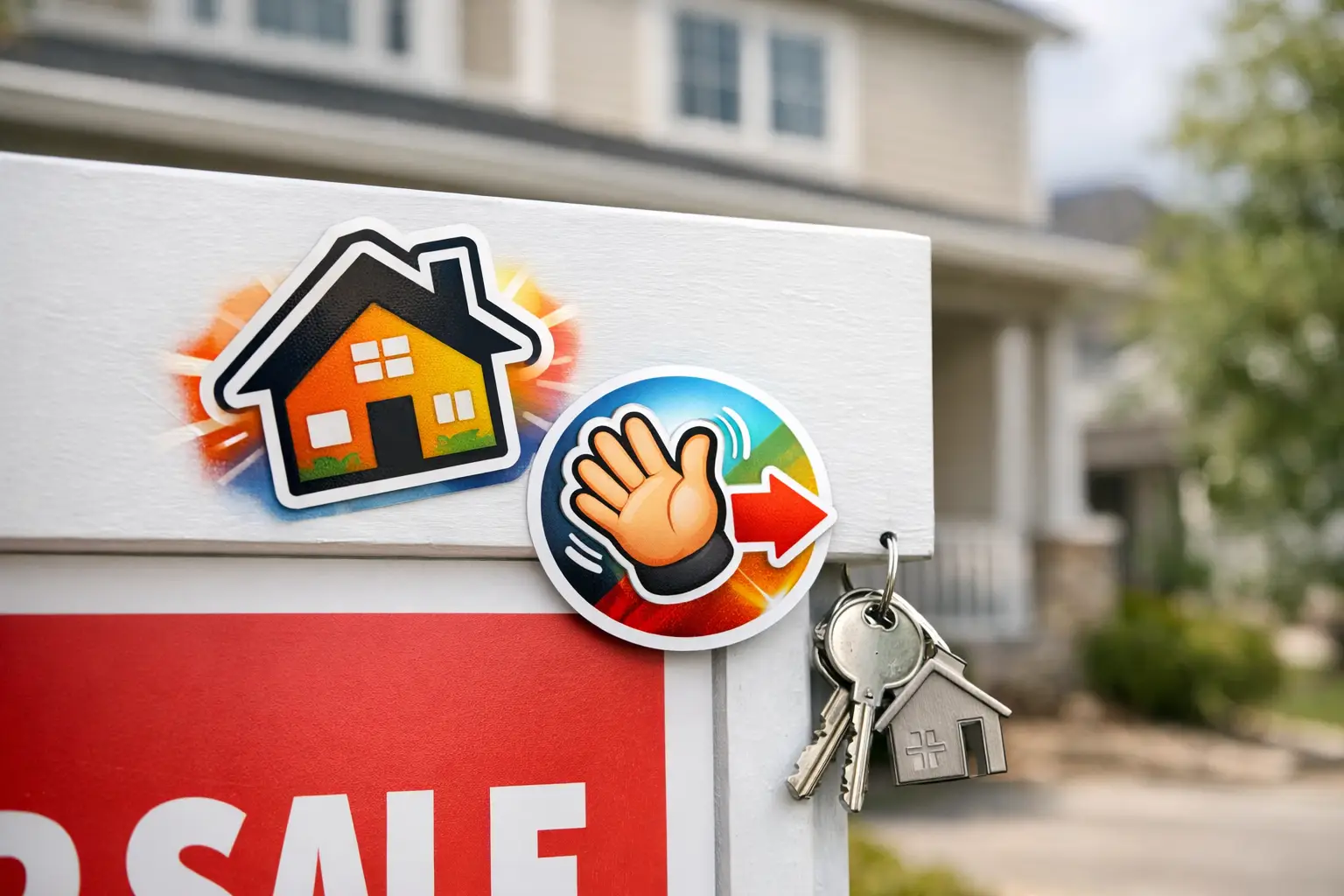
A sold sticker slapped crooked across a premium listing board is a small detail, but buyers and vendors notice it straight away. So do neighbours walking past, future sellers sizing up your brand, and anyone scrolling local Facebook groups after spotting your sign on the street. Real estate stickers do more than update a listing. They shape how polished, active and trustworthy your agency looks in the market.
That matters because real estate is a visibility game. If your stickers fade, peel, bubble or look cheap, the message is obvious. If they’re clean, sharp and built for the conditions, they quietly do their job every single day while your team gets on with appraisals, opens and campaigns.
Why real estate stickers still pull their weight
There’s a reason agencies keep coming back to stickers even with digital campaigns doing the heavy lifting elsewhere. They’re fast, cost-effective and incredibly flexible. A good sticker can turn a generic sign into a live campaign asset in seconds. It can update pricing, highlight an auction date, add agent branding, push a sold result or direct people to a display suite without reprinting an entire board.
For busy agencies, that’s a practical win. Replacing full signage every time a detail changes is slow and expensive. Stickers let you move quickly, keep branding consistent and stretch the life of your existing print collateral.
There’s also the local exposure factor. Real estate marketing is not just about the active buyer. It’s about the owner down the road who notices your sold sticker, sees your brand again two streets over, and starts thinking about calling for an appraisal. Strong street presence builds familiarity. Familiarity builds trust. Trust gets you invited into more lounges.
Where real estate stickers work best
Most people think of real estate stickers as just sold overlays for corflute boards. That’s the obvious use, but it’s not the only one. Agencies use them across signboards, windows, office displays, directional signage, brochure packs, settlement gifts and branded assets at opens.
Window stickers are especially handy for agencies with a prominent shopfront. They can promote current listings, recent sales, leasing wins or brand messaging without locking you into something permanent. If your portfolio shifts regularly, removable or short-term options make more sense than fixed signage.
On-site boards are where durability really counts. Outdoor conditions in Australia are rough. Full sun, wind, rain and heat will test any print product quickly. A sticker that looks great on day one but curls at the edges by week two is a waste of time. For outdoor property marketing, materials and adhesive quality matter more than flashy extras.
Then there’s vehicle branding. Not every agency wants a full wrap, and fair enough. Real estate stickers can be a smart middle ground for adding logos, contact details or campaign promotion to agency cars without the cost and commitment of larger signage.
What makes good real estate stickers actually good
The short answer is this: they need to look sharp, stick properly and survive the job they’ve been given.
Print quality is the first thing people notice. Fine text needs to stay readable. Brand colours need to stay consistent. Photos, logos and contact details should look clean, not muddy or pixelated. Real estate branding usually leans hard on polished presentation, so rough-looking stickers can drag down the whole campaign.
Material choice comes next. Indoor office use and outdoor board use are different jobs. A sticker for a short weekend campaign in a protected area doesn’t need the same toughness as one sitting in direct sun on a roadside board for weeks. That’s where a proper proofing and support process makes a difference. You don’t want to guess your way into the wrong product.
Adhesive matters too, and this is where plenty of people get caught. Go too aggressive and removal becomes a pain. Go too light and the sticker lifts before the campaign is halfway through. It depends on the surface, how long it needs to stay on, and whether the underlying sign needs to be reused.
Finish also plays a part. Gloss can make colours pop and feel bold, which suits high-visibility branding. Matte can look more premium and cut glare, especially useful when stickers are being photographed or viewed in bright conditions. Neither is always right. It comes down to where the sticker will live and what you want it to do.
Choosing the right format for your agency
Not every agency needs the same setup. A boutique office with a tightly curated listing base might want smaller runs with premium finishes and exact colour matching. A high-volume sales team across multiple suburbs may care more about repeatability, speed and easy reordering.
Die cut stickers are a strong option when shape matters and you want branding to feel a bit more custom. Cleanly cut logo stickers or agent-branded decals can lift presentation without trying too hard. Kiss cut stickers can be easier to peel and handle, which helps when staff are applying them quickly across multiple boards or packs.
If you’re producing sold, leased or under offer overlays in bulk, practical sizing and application speed usually matter more than fancy shapes. The smartest format is often the one your team can use without fuss. No one in a busy agency wants to wrestle with awkward backing paper five minutes before an open.
Design mistakes that cost you attention
Real estate stickers are usually working in seconds, not minutes. People see them while driving past, walking the dog or glancing out the car window at the lights. That means clarity wins.
Too much text is a classic mistake. If the point is sold, say sold. If the point is open time, make that the hero. Tiny supporting details can be useful, but don’t cram the sticker with every possible message and expect it to land.
Poor contrast is another killer. If your brand palette uses subtle tones, it may look great in a style guide and terrible on a roadside board. High contrast makes stickers easier to read fast. That doesn’t mean ugly. It means deliberate.
Then there’s inconsistency. Different fonts, shifting colours, awkward logo placement and off-brand layouts make agencies look disjointed. A sticker should feel like part of the campaign, not an afterthought thrown on at the last minute.
Speed matters more than most agencies admit
The best-designed sticker in the world is useless if it arrives after the campaign has moved on. Real estate timelines shift constantly. Listings launch early, price points change, boards need updating and sold results need to go up while the momentum is fresh.
That’s why fast turnaround is not just a nice extra. It’s operationally important. Agencies need suppliers who can move quickly, communicate clearly and sort artwork issues before they become delays. If a proof needs tweaking, you want that picked up early, not after the job has gone to print.
This is also where local production can make a real difference. Faster dispatch, easier communication and more confidence in quality control all help when your deadlines are tight and your reputation is on the line.
Are cheap real estate stickers worth it?
Sometimes, yes. Often, no.
If you need a short-term sticker for a brief indoor promotion, a budget option might do the trick. But if it’s representing your agency outdoors in a competitive market, cheap usually shows. You’ll see it in the print sharpness, the finish, the adhesive performance and how well it holds up once the weather gets involved.
There’s a difference between cost-effective and cheap. Cost-effective means the sticker does its job properly for the intended use. Cheap means you’re crossing your fingers and hoping it lasts long enough not to embarrass you.
For agencies serious about brand presentation, that trade-off rarely pays. A polished sticker run doesn’t just support one listing. It supports how the market perceives your agency as a whole.
Real estate stickers are small, but they’re not minor
This category gets overlooked because it feels simple. But simple products are often the ones that show the cracks fastest when quality isn’t there. A good sticker should apply cleanly, read instantly and hold up without drama. That’s the job.
If you’re ordering for an agency, think beyond the unit price. Think about visibility, consistency, turnaround and whether the final product makes your brand look switched on. That’s the real value.
And if a sticker can help your next listing board look sharper, your recent sale stand out, or your agency feel more active on the street, it’s doing a lot more than taking up space.
Leave a Reply
You must be logged in to post a comment.