
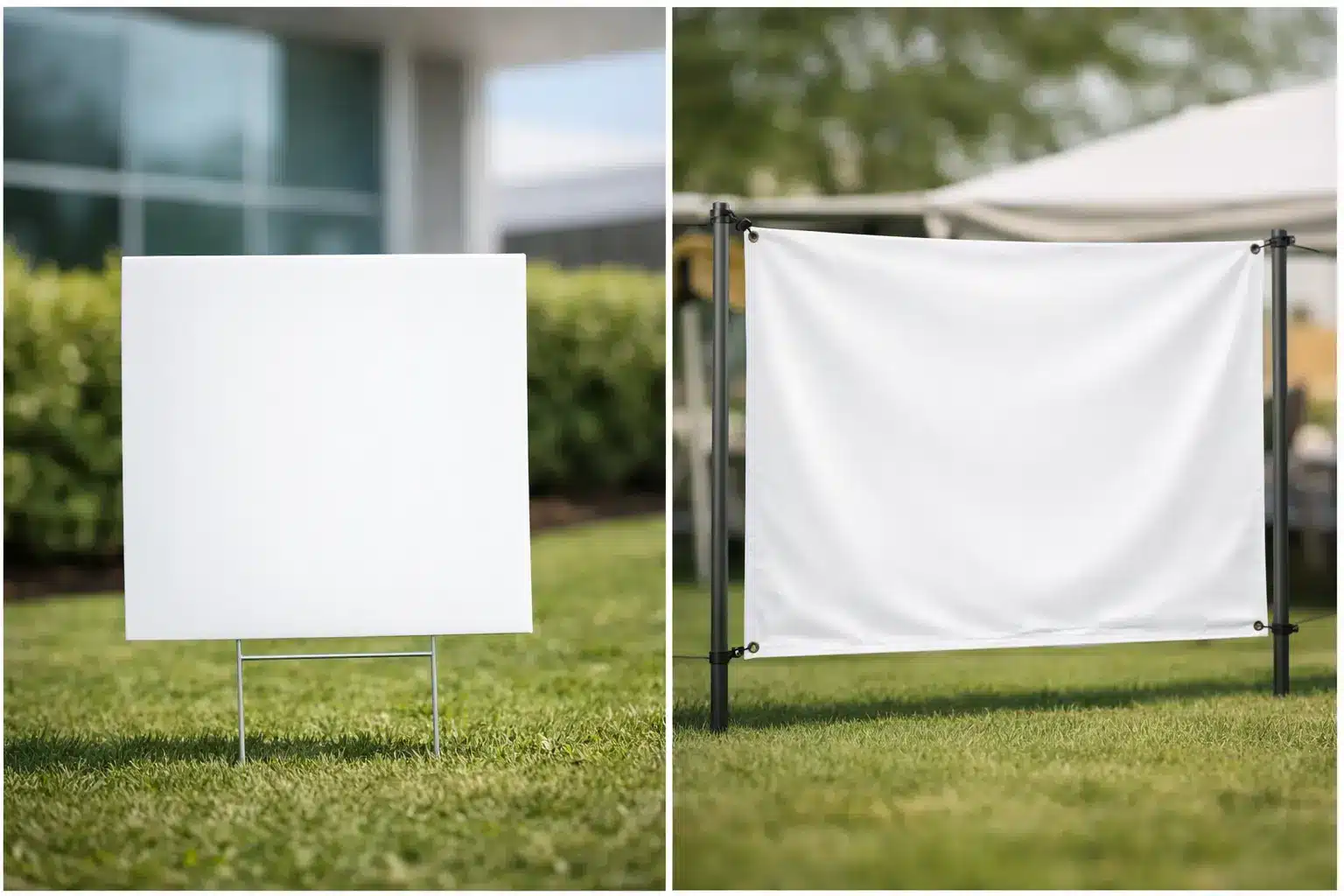
A weekend open home, a busy trade site, a school fete or a market stall can all have the same problem: people need to spot you before they walk past. When weighing up corflute signs versus banners, the best choice comes down to where it will sit, how long it needs to last and what job it needs to do.
Both formats can put your brand, message or directions in front of the right people. But they behave very differently once they are out in the real world – in the wind, on a fence, beside a road or under a marquee. Here is the no-fuss way to choose.
Corflute signs versus banners: the quick answer
Choose corflute when you need a rigid, lightweight sign that can be mounted, staked, leaned or fixed in place. It is a brilliant option for real estate boards, construction site notices, event directions, election signage, parking instructions and short-term promotions.
Choose a banner when you need a larger message with flexibility. Banners suit fences, shopfronts, market marquees, sporting grounds, stages and temporary activations where distance visibility matters more than a rigid panel.
Neither is automatically better. A corflute sign is usually easier to position neatly at ground level or on a post. A banner often gives you more visual impact across a wide space. The smart move is matching the material to the setting, not forcing one product to do every job.
What corflute signs do best
Corflute is a fluted polypropylene board. The internal channels keep it light while giving it enough structure to stand flat and look clean. If you have seen property signs attached to stakes, site safety messages on a temporary fence or directional arrows around an event, you have probably seen corflute at work.
Its biggest advantage is rigidity. A corflute sign holds its shape, so your artwork stays easy to read. That matters for information people need to absorb quickly, such as an auction time, site entry point, QR code, safety instruction or parking direction. It also photographs well, which is handy when your event signage appears in social posts and recap photos.
Corflute is also practical to install. Depending on the location, it can be attached to fences, mounted to posts, placed in an A-frame, zip-tied to barriers or staked into suitable ground. It is light enough to carry in the back of a ute, yet much tidier than a sheet of paper taped to a wall.
For temporary outdoor use, it is a solid all-rounder. Rain is rarely the issue. Wind is the bigger consideration, especially for larger boards or exposed sites. A corflute sign still needs proper fixing, and a loose sign can quickly become a wonky sign.
Best uses for corflute
Corflute earns its keep where a sign needs to be firm, clear and close to the viewer. Think real estate inspections, building sites, local campaigns, wayfinding, retail point-of-sale, sporting events, school functions and roadside promotions where local rules allow signage.
It is particularly useful when you need several signs with different messages. One board can say Registration, another can point to Parking, while another directs guests to the entrance. Keeping the size, colours and branding consistent makes the whole setup feel organised without blowing out the budget.
Where banners have the edge
Banners are built for scale. When your message needs to stretch across a fence line, span the front of a stall or stand out behind a registration desk, a banner gives you more room to work with.
That extra space changes how people see your brand. A banner can carry a big logo, a strong headline, a call to action and supporting details without making the design feel cramped. For clubs chasing sponsors, tradies promoting services, event organisers selling tickets or retailers running a sale, that broad visual real estate is hard to beat.
Banners are also easier to roll up, pack away and reuse. If you attend markets, expos, community events or race days throughout the year, one well-designed banner can become part of your regular kit. Store it dry, roll it rather than folding it where possible, and it will be ready for the next setup.
The trade-off is movement. A banner catches the wind far more readily than a rigid board. Eyelets, strong ties and sensible placement matter. On a windy oval, coastal site or open car park, allow for tension and avoid treating a banner like it can be fixed with one hopeful cable tie at each end.
Best uses for banners
Banners work brilliantly for long viewing distances and big, open surfaces. Use them on temporary fencing, market marquees, sports club railings, shopfronts, event entrances, stages, warehouse walls and roadside-facing sites where you have permission.
They are especially effective when the same message needs to work for a crowd. A sponsor banner at a junior footy club, for example, can stay visible all day without requiring visitors to walk up close. A corflute sign would need to be much closer to have the same effect.
Compare visibility, durability and cost properly
The most common mistake is choosing based on price alone. A cheaper sign is not a bargain if it is too small to read, poorly fixed for the location or unsuitable for the campaign.
For close-range readability, corflute is often the winner. Its flat surface and rigid edges make it ideal for direct instructions. If someone is driving into a car park or walking through an open home, they should be able to process the message in seconds. Keep the wording short, use high-contrast colours and make the key action the largest element.
For larger-scale visibility, banners usually win. Their size lets you use bolder branding and bigger type, which gives people more time to notice the message from across a field, road or shopping centre walkway. Just do not fill every centimetre with information. Bigger print is only useful when the design has breathing room.
On durability, both can perform well for temporary outdoor campaigns when printed properly and installed with care. Corflute can bend or crease if mishandled, while banners can flap, stretch or tear around poorly supported eyelets. The environment decides the risk. A sheltered indoor event is forgiving. A windy, wet site needs a more considered setup.
Cost depends on quantity, size, finishing and how often you plan to use the item. Corflute can be a sharp choice for multiple short-term signs. A banner may deliver better value when you want one large reusable display. Work backwards from the campaign: how many locations, how long, how far away will people stand, and will you use it again?
Design rules that work for both
Great print cannot rescue a cluttered message. Whether you choose a board or a banner, people should understand the point before they have time to lose interest.
Start with one priority. It could be “Auction Today”, “Free Quote”, “Enter Here” or your business name and phone number. Then support it with only the details needed to take the next step. A QR code can work well, but it needs enough clear space around it and should not be the only way someone can act.
Use colours with contrast. Pale yellow text on white might look subtle on a screen, but it will disappear in harsh Australian sunlight. Dark text on a light background, or light text on a dark background, is the safer play. Use large fonts, avoid skinny typefaces and check your artwork at actual viewing distance before ordering.
If your business already uses branded stickers, flyers or vehicle graphics, carry the same colours, logo treatment and tone onto your signage. That repetition builds recognition. Sticker Ninja customers often get the strongest result when their event print feels like one brand, not a pile of unrelated materials.
Pick the format for the job, then install it like you mean it
Go with corflute when the sign needs to be rigid, directional and easy to place at eye level or ground level. Go with a banner when you need a big, reusable statement across a large area. For many events, using both is the best call: banners pull people in from a distance, while corflute signs tell them exactly where to go once they arrive.
Before printing, inspect the site, measure the available space and think about wind, fixing points and viewing distance. A good sign does not just look the part. It stays put, gets read and makes the next step obvious.