
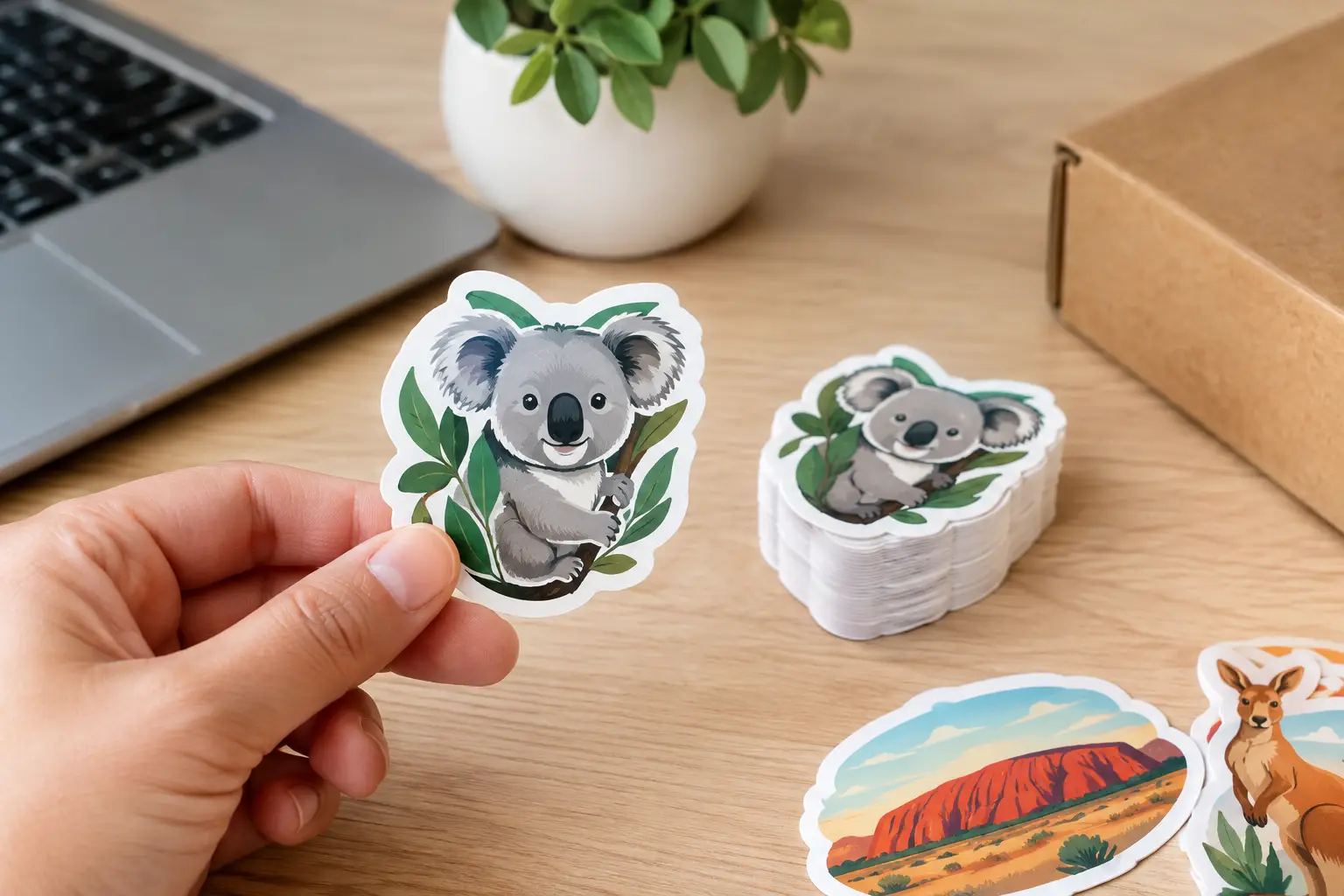
A kiss cut sticker can make a small branding moment feel properly premium. In this kiss cut stickers review, we look at what separates this format from a standard die cut sticker, where it performs best, and whether it is the right call for your next promo, product launch or event pack.
The short version: kiss cut stickers are a top pick when presentation matters as much as the sticker itself. You get a custom-shaped design that stays attached to a larger backing sheet, making it easier to peel, easier to hand out and much less likely to end up bent, lost or stuck to the wrong thing before it reaches your customer.
What are kiss cut stickers?
A kiss cut sticker is cut through the vinyl layer but not all the way through its backing paper. Your logo, illustration or message is cut to shape, while the backing remains as a neat square, rectangle or custom outer shape around it.
That outer backing is the difference. With die cut stickers, the sticker and backing are both cut to the same outline. They look sharp and work brilliantly for individual giveaways. Kiss cut stickers give the recipient more to hold onto, along with a clean edge for peeling.
Think of a detailed logo with fine points, a character design, a QR code, or a sticker with several separate visual elements. Those are exactly the jobs where kiss cutting earns its keep. The sticker still has its custom contour, but it is protected by a practical border.
Kiss cut stickers review: the real advantages
The biggest win is usability. Small, intricate stickers can be frustrating to lift from a backing that follows every tiny curve. A kiss cut format gives fingers a clear starting point. That sounds minor until you are packing hundreds of stickers for a market stall, conference bag or mail-out.
They also present better. The backing sheet creates a tidy frame around the design, which makes branded stickers feel deliberate rather than like an afterthought tossed into an order. For cafés, tradies, real estate teams, clothing labels and local businesses, that extra polish helps your brand look organised from the first touchpoint.
Kiss cut stickers are also well suited to artwork with delicate details. Fine antennae on a mascot, pointed lettering, wavy linework and close-cut photographic designs are less exposed during handling. The backing offers support before application, so your stickers arrive looking the way they should.
There is a marketing angle, too. The backing can carry an extra printed message if your design allows for it. A simple “stick it somewhere good”, a campaign tag line, event details or a social handle can turn a free sticker into a more memorable brand piece. Keep it uncluttered, though. A great sticker does not need to shout from every millimetre.
Where this format works best
Kiss cut is not a one-size-fits-all answer. It is a strong choice for businesses and organisers who want stickers to be handled, shared and applied with minimal fuss.
For product packaging, they make a polished addition to online orders. A custom sticker tucked into a parcel can encourage customers to put your logo on a water bottle, laptop, notebook or tool box. That is brand visibility you do not have to keep paying for.
For events, kiss cuts are a safe bet for welcome packs, show bags, club merchandise and fundraising bundles. Their backing means volunteers can distribute them quickly without battling curled edges or trying to separate tiny shapes. If you are organising an event on a tight deadline, that kind of practical detail matters.
For creative brands, the format gives illustrations room to breathe. Artists, tattoo studios, bands and car groups often use kiss cut stickers for designs people want to collect. A clean border around the artwork can make even a bold, busy graphic look more finished.
They are also a handy option for QR-code stickers, provided the code is large enough and kept clear. The outer backing creates a natural place for a short instruction such as “Scan for a quote” or “See the full range”, while the sticker itself remains clean and scannable.
The trade-offs worth knowing
Kiss cut stickers are not automatically better than die cut stickers. They are better for a particular job.
If you want the sticker itself to have maximum impact as a standalone giveaway, die cut can be the punchier choice. There is no outer border, so the custom shape is all people see. It is ideal for simple logos, bold icons and designs that will be handed out one at a time.
Kiss cut stickers can also feel slightly larger in the hand because of the backing sheet. That is useful for presentation, but it may not suit a tiny, minimalist design where you want the finished piece to be as compact as possible. For large quantities, consider storage and how the format fits into your packaging.
The design needs a little more thought as well. A very narrow gap between the sticker edge and backing edge can reduce the peel benefit. Too much empty space can make the sticker look undersized. A balanced border gives customers something easy to grip without distracting from the artwork.
What quality should you expect?
A decent kiss cut sticker should look crisp before it is even peeled. Colours need to print cleanly, blacks should look solid, and small text should be legible at the final size. The cut line should follow the design accurately, without clipping important details or leaving awkward chunks of background behind.
Then there is the material. Indoor use and outdoor use are different jobs. A sticker for laptops, drink bottles and product boxes needs a clean finish and good adhesion. A sticker going on a ute, hard hat, wheelie bin or outdoor sign needs weather-resistant stock and inks that stand up to sun, rain and general Aussie punishment.
Surface prep still matters. Even the best sticker will struggle on dusty, oily, damp or heavily textured surfaces. For the strongest hold, apply it to a clean, dry, smooth surface and press firmly across the whole design. If you are giving stickers away for outdoor use, it is worth including that advice in your packaging or at the point of handover.
Getting the artwork right before print
Good artwork makes ordering far easier and the final result much sharper. Use a high-resolution file, ideally with a transparent background if the sticker is being cut around your design. Keep important text and details away from the cut edge, particularly if the design has thin lines or tiny type.
If you are unsure whether your logo will work as a kiss cut, do not guess. A proofing check is where a specialist printer earns their stripes. Sticker Ninja can help identify cut-line issues before production, which is far better than discovering your fine print is too fine after a whole run has arrived.
For a clean result, simplify where needed. A sticker viewed from arm’s length does not need every detail from a full brochure layout. Make the logo readable, give the design contrast, and choose a size that suits where people will actually stick it.
Is kiss cut worth ordering?
For most promotional uses, yes. Kiss cut stickers are worth the extra consideration when you have an intricate design, want a premium handout, or need customers to peel and apply the sticker without a wrestling match. They are especially good for businesses that want their merch and packaging inserts to feel considered, not generic.
Choose die cut instead when the sticker shape itself is the hero and you want the smallest, boldest individual giveaway. Choose a sticker sheet when you have several designs or want people to pick their favourites. The right format comes down to how it will be used, not just how it looks on screen.
If your sticker is going into someone’s hand, parcel or event bag, make that first impression count. A well-designed kiss cut sticker is easy to peel, hard to ignore and far more likely to end up somewhere people will see it.